
When Pain Follows a Path: Discovering the Connection Between Dermatomes and Nerve Pain (or Skin Rashes!)

What led to my understanding the connection between dermatomes and nerve pain, as well as skin rashes...!

It all began on an ordinary Friday afternoon — nothing heroic, just me hoisting a five-gallon water jug down the hallway to refill the office cooler. By evening, my left side was sore. “Typical,” I thought, chalking it up to a bit of overexertion.
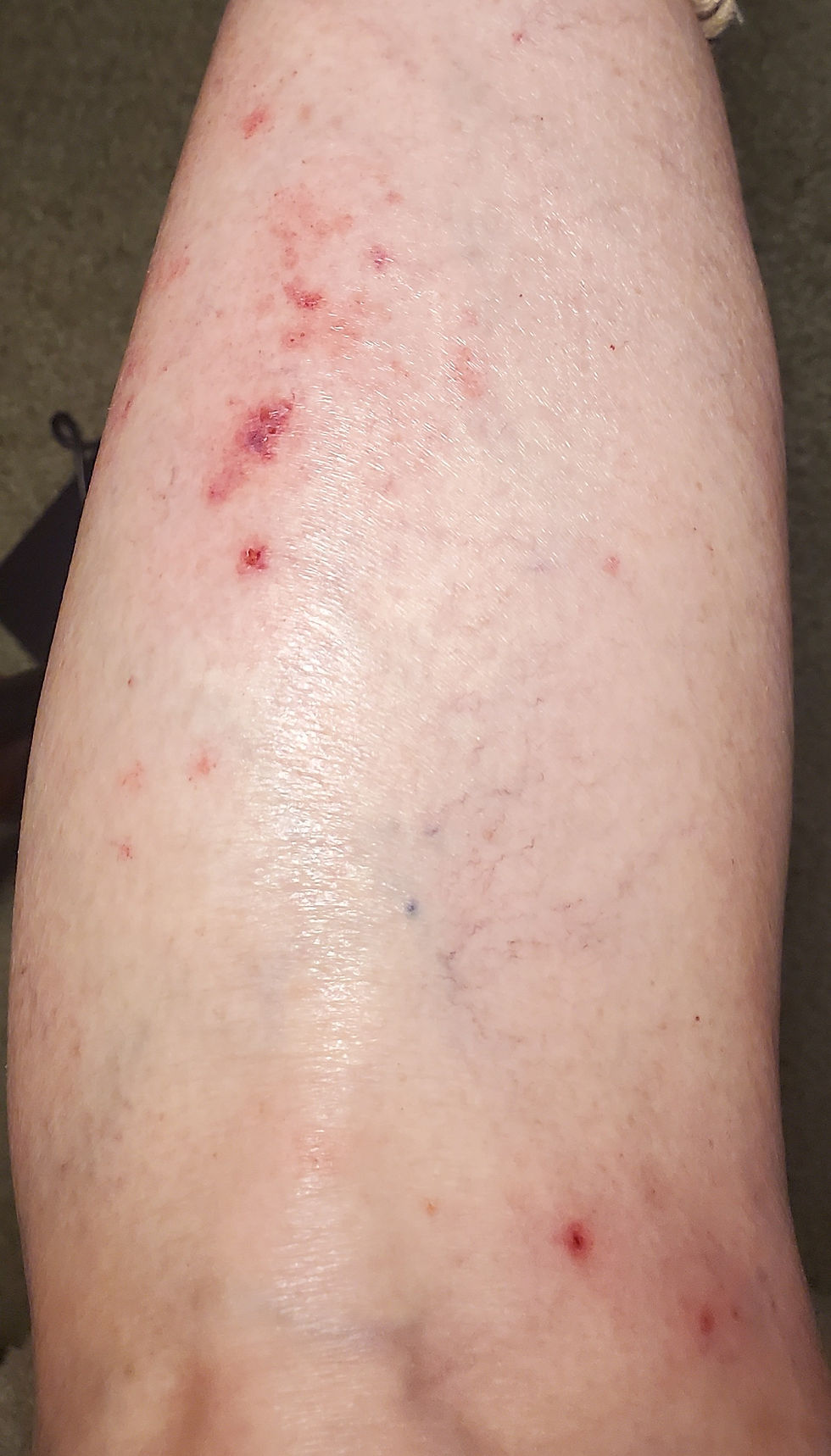
But by the next morning, something new appeared: itchy red patches on my left leg — one beside the knee, another streaking down the shin. The placement was so peculiar that my first thought was, Did I get bitten by something in my sleep? Then, remembering that I’d strained my back, I wondered if I’d somehow triggered an autoimmune flare, such as dermatomyositis, but that seemed entirely far-fetched. None of it fit.
And then, early the next morning, as I was walking across the room, a word popped into my mind out of nowhere: dermatome.

A quick look at a dermatome chart, and there it was — the L4 and L5 nerve roots mapped exactly to the areas of my rash. The two spots beside my knee? L4. The streak down the shin? L5. Even an itchy, rash-free patch to the left of my left butt-cheek and another on the top of my foot traced that same L5 pathway.
That’s when it hit me:
What happens in L4–L5 doesn’t stay in L4–L5.
It was a living anatomy lesson — my own skin reflecting my lower spine.
Stories From the Field
Once I shared my discovery, the synchronicities began to surface.

One woman told me that whenever she’s out shoveling snow, her knees and shins start to itch like crazy. Her husband insists it’s the cold, but she swears she’s perfectly warm. As it turns out, she has an iffy back — and the itching always strikes when she’s been shoveling snow. Her knees and shins? L4 and L5 again.
Then during the live webinar, a client and participant typed into the chat that she’d had itchy, dry skin on the front of her left shin for weeks. Her back had also been bothering her, and x-rays had recently revealed bulging discs at L4 and L5. She wrote:
“I would never have bothered you about the itchy leg!”and added that she was double-dosing her PEA for back pain but had never made the connection between the two.
The chat lit up. Another participant said, “Wowsers! This is amazing!” And indeed it was.

Connecting the Dots
The more I study, the more fascinating it becomes. When a spinal nerve root becomes irritated — whether by compression, inflammation, or even a virus such as shingles — the skin it serves often reacts, too. The result can look like a rash, feel like itching, or simply tingle or go numb. It’s called a neurogenic reaction, and it follows the exact pathway of the affected nerve — the dermatome.
In my case, there was no bug bite, no allergy, no skin disease at all. It was simply my L4–L5 nerve roots “speaking” through my skin.

So yes — what began as back strain turned into a vivid reminder that our bodies are exquisitely connected. The spine and the skin aren’t strangers; they’re conversation partners. And next time you find yourself scratching an odd patch of skin and wondering what on earth it means, remember — it might not be the skin that’s talking, but the nerve behind it.

In Closing
Isn’t the body incredible? The more we listen, the more we realize that symptoms are rarely random — they’re messages waiting to be understood. Whether it’s an aching back, an odd patch of skin, or an unexplained itch, it all traces back to the same marvelous network of nerves and communication, including the connection between dermatomes and nerve pain.
If this topic fascinated you, be sure to watch the full replay of my Wondrous Roots Live webinar, “When Pain Follows a Path: Understanding Dermatomes & the Body’s Neural Map,” where we explore real-life stories, diagrams, and natural ways to support nerve health. Go here to find the video, full pdf of the slides for viewing and/or download, and more! Body Parts | Wondrous Roots
